Loneliness survey: many children feel the need to talk, but lack the space for difficult conversations at home
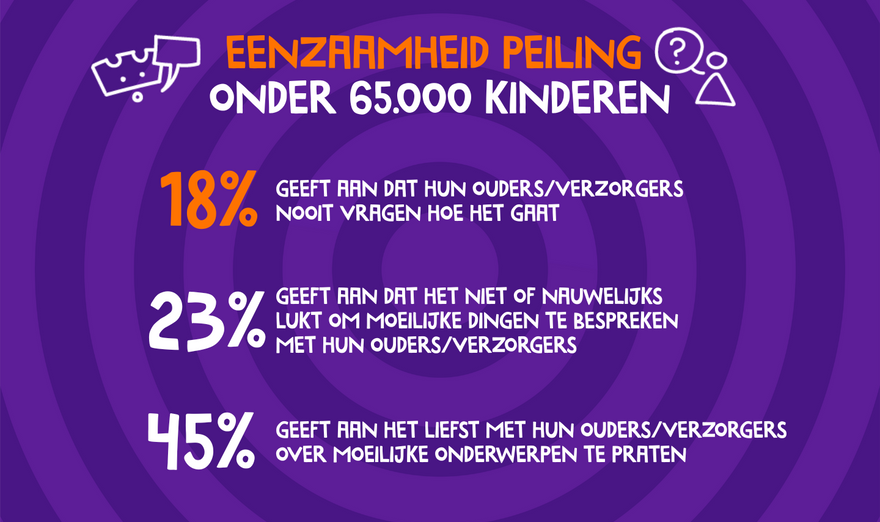
- 18% of children say their parents or caregivers never ask how they are doing.
- 17% experience that parents try to discuss difficult topics, but are unsuccessful.
- 6% indicate that they are never able to talk to their parents or caregiver about difficult topics.
- 45% prefer to talk to their parent or caregiver when they feel lonely.
Many children indicate that they prefer to talk to their parent or caregiver when they feel lonely. At the same time, 23% indicate that they have little or no opportunity to discuss difficult topics with their parents. This is evident from our extensive loneliness survey, conducted among 65,000 primary school children at the launch of the children's stamp campaign last week. We warn that children's signals too often go unnoticed and that talking is crucial to prevent larger, long-term problems.
The loneliness survey is a follow-up to a 2024 study on childhood loneliness, commissioned by Kinderpostzegels and conducted by Utrecht University and the Verwey-Jonker Institute. This study found that 1 in 10 children feels lonely often to always.
'Loneliness is a hollow feeling inside. That no one sees you and talks to you, as if you don't exist' Luna (10)
Break the taboo: talk to children about loneliness
This new survey specifically asked whether children can talk to their parents or caregivers about difficult topics, such as loneliness. The results show that while this need exists, it's far from always self-evident.
Sofie Vriends, director of Kinderpostzegels (Children's Stamps): " The fact that so many children feel lonely and don't feel the space to talk about it at home is truly worrying. Loneliness among children isn't an individual problem, but usually a sign that something is wrong in the child's environment. Parents, schools, policymakers, everyone who works with children, must be aware of these signs. That's why we need to take the time, ask questions, and not avoid difficult topics, but rather make them open to discussion. Normalize the feeling by explaining that loneliness is a human feeling that everyone experiences at times, and thus remove the shame children feel from talking about it. Also, share examples of times when you felt lonely yourself. By talking about it, we can prevent loneliness from developing into bigger problems. Every child deserves to be truly seen and heard ."
We emphasize the importance of discussing difficult topics like loneliness within families. Loneliness in children is not only detrimental to their well-being but also often a risk factor for mental health problems later in life; it's a sign that something else is going on. By breaking the taboo and taking children's feelings seriously, we can prevent these silent signals from escalating into bigger problems.
About the poll
The loneliness survey was conducted among 65,000 primary school children from 4,604 grades 7 and 8, immediately following the launch of the children's stamp campaign. Children were able to provide their answers anonymously. This year's survey focuses on "Together against loneliness." It builds on our 2024 research, conducted by Utrecht University and the Verwey-Jonker Institute.