(No) Opportunities Board for Children in Emergency Shelters
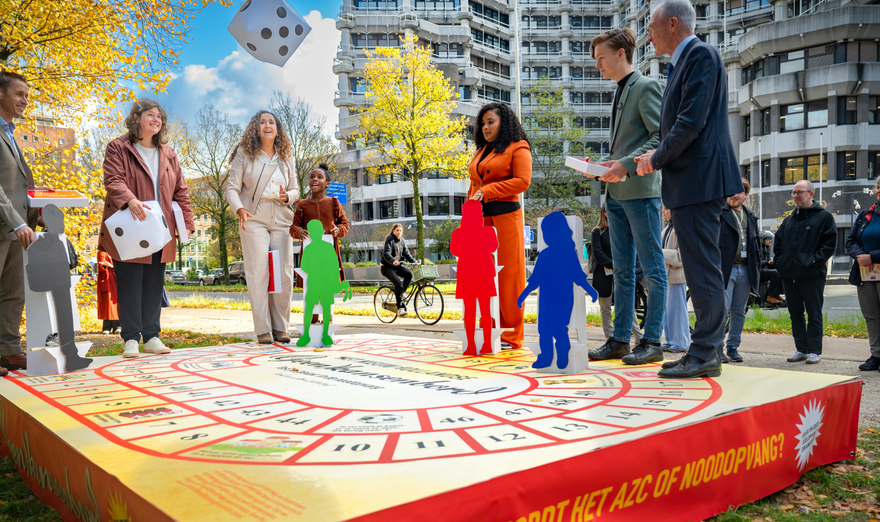
The number of children in emergency shelters has increased by 65% in one year, according to the second Children's Rights in Motion monitor, which the Children's Rights Collective will publish on October 22, 2024. The Children's Rights Collective finds the situation of children in emergency shelters unacceptable. It is a 'game of chance' whether children's rights are observed in emergency shelters. Therefore, the Children's Rights Collective is symbolically building a large opportunities board on the lawn in front of the Dutch Parliament. At 12 PM, politicians and passers-by are invited to play the new Dutch (No) Opportunities Board Game on the life-size game board, inspired by the old Dutch Game of the Goose. By rolling a dice and moving steps on the board, they will experience for themselves how few opportunities children have for their rights to be respected.
Court of Appeal ruling
The Court of Appeal in The Hague previously ruled that children may not be placed in emergency shelters unless their specific needs are met there. Although the shelters structurally fail to meet these requirements, there are now 5,566 children in emergency shelters. 'Children's rights are trampled on daily in emergency shelters, which is why we believe children should be immediately removed from emergency shelters,' says Marc Dullaert, chairman of the Children's Rights Collective. 'The UN Committee on the Rights of the Child already admonished the Netherlands for the poor situation of children in emergency shelters. Our new monitor shows today that the Netherlands is doing far too little to improve this. In fact, the situation for children is worsening now that an asylum crisis is being invoked. If the Distribution Act is withdrawn, even more children will end up in emergency shelters.'
More and more children
At the beginning of July 2023, there were still 3,378 children in emergency shelters. Despite all investigations and calls from government inspectorates that children suffer harm in emergency shelters, that number had increased by 65% to 5,566 by the beginning of July 2024. The number of children in emergency shelters has more than doubled in the past two years. The UN Committee on the Rights of the Child, which monitors compliance with the Convention on the Rights of the Child in the Netherlands, made an unmistakable appeal to the Netherlands two years ago: prioritize the immediate removal of children and their families from emergency shelters and invest the necessary resources in improving and expanding child-friendly reception facilities, so that facilities do not become overcrowded and children are not frequently transferred to other locations.
Children's rights violated
Asylum reception for children in the Netherlands is a challenging path. It depends on chance whether a child ends up in an emergency shelter or a regular asylum seeker center. Whether they can go to school or not. Whether they have access to medical care and vaccinations or not. Whether they have to move multiple times a year or not. Children in emergency shelters daily face highly detrimental living conditions.
Child-friendly reception
'Child-friendly asylum reception is a child's right, and should not be a game of chance,' says chairman Marc Dullaert. 'Emergency shelters are totally unsuitable reception locations for children. The Distribution Act must be implemented so that small-scale and child-friendly reception can be realized as quickly as possible and the Netherlands complies with the UN Convention on the Rights of the Child.'
Monitor Children's Rights in Motion
With the online monitor Children's Rights in Motion, the Children's Rights Collective annually shows how far the government is in following the advice of the UN Committee on the Rights of the Child. Children's Rights in Motion presents data and policy changes from the past year. It illustrates movement in ten themes and where much more action needs to be taken.
About the Children's Rights Collective
Kinderpostzegels is, together with Augeo Foundation, Defence for Children, the National Youth Council (NJR), Save the Children, and Terre des Hommes, part of the Children's Rights Collective, with the Netherlands Youth Institute (NJi) as an advisor. Additionally, numerous civil society organizations working with or for children are affiliated with the collective. Together, we give a voice to the rights of the child.
Top 5 children's rights violations in emergency shelters:
1. Frequent relocation
Children have to move six to eight times during their asylum procedure. Regular relocations are harmful to a child's development. They experience attachment issues and fall behind in learning.
2. Long wait for education
The law states that a child must be able to go to school within three months. This is very often not achieved. Not all emergency shelters have a school nearby. Or schools no longer have space. As a result, children go months without education. School provides children with stability and structure. These children want to learn to progress. Due to relocations, it can also take a long time before they can start at a new school.
3. Lack of privacy and safety
Often, children stay with many people in one room or smaller rooms with partitions through which everything can be heard. Children need space to withdraw and process new impressions and experiences. And to feel safe. There is also a lot of noise; poor sleep leads to low concentration at school and a gloomy feeling.
4. Lack of healthcare
Access to medical and psychological care in emergency shelters is insufficient, meaning children do not receive the care they need. Children miss their vaccinations, and infectious diseases such as whooping cough or measles are not always screened for. And they have to wait a long time to see a doctor.
5. Lack of a confidant
In emergency shelters, there is no point of contact or listening ear for the children. If a child wants to talk to someone, they end up on a waiting list for months.