Talk about it and break the taboo
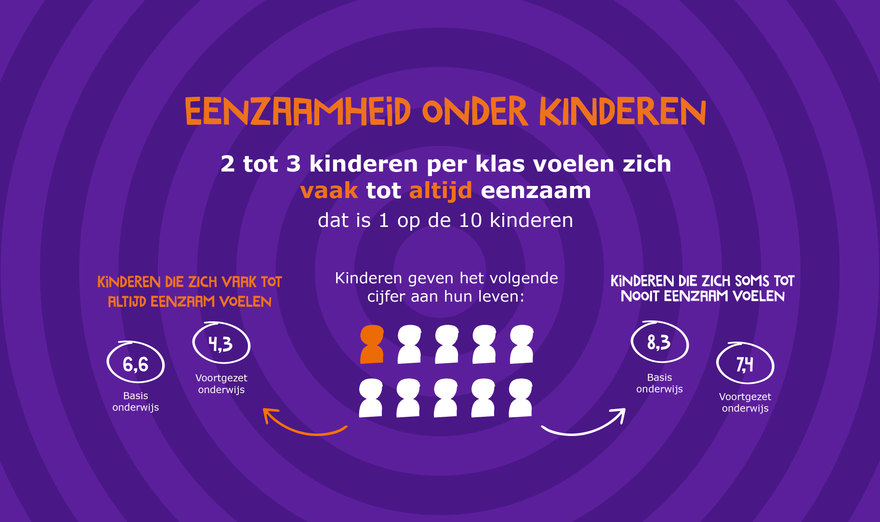
Every classroom contains two to three children who often, if not always, feel lonely. Even in primary school. This is the conclusion reached by researchers from the Verwey-Jonker Institute and Utrecht University, commissioned by Kinderpostzegels (Children's Stamps). What can we do together to address this?
Being bullied or excluded, feeling pressured at school, having no one around to support you unconditionally: loneliness is an emotion that deeply affects children. It erodes their sense of happiness and causes mental and physical problems.
This is evident from research conducted by Utrecht University and the Verwey-Jonker Institute, commissioned by Kinderpostzegels (Children's Stamps Foundation). The study combines knowledge from literature and interviews with experts and children with data from over 6,000 children and young people from the "Young after Corona" study by Utrecht University and the Trimbos Institute.
Already at a young age
In recent years, loneliness among young people has been receiving increased attention. For the first time, a more detailed study has been conducted on loneliness among a large, representative group of children in grades 6, 7, and 8 of primary school. Loneliness also appears to be a significant problem among them. As many as 1 in 10 children feels lonely often to always. This means that in every primary school class, there are two or three children who feel lonely. These children give their lives a significantly lower grade: a 6.6 instead of the 8.3 that other children rate their lives. The study cites (online) bullying, pressure at school, and a lack of support in their environment as major causes. Social media and gaming are also often cited as causes of problems in children and young people. The study shows that social media and gaming can be problematic for some children, but can actually help combat loneliness for others.
'Loneliness is a hollow feeling inside. That no one sees you and talks to you, as if you don't exist' Luna (10)
Major consequences
Long-term loneliness often has serious consequences, both now and in the future. For example, loneliness can lead to mental health problems such as anxiety, depression, and low self-esteem. Loneliness also frequently causes problems at school. Relationships with peers and teachers can deteriorate, as can academic performance. Furthermore, loneliness often has physical consequences. For example, children who feel lonely sleep worse and visit the doctor more often.
Sofie Vriends, CEO of Kinderpostzegels, is shocked by the scale and severity of the problem. " The fact that so many young children feel lonely is very worrying. Especially because we already know the long-term consequences. Loneliness undermines the strong foundation that every child needs. And that can have lifelong repercussions ."

Recommendations
What can we do together to combat loneliness? The researchers, in consultation with experts and children themselves, offer recommendations.
First and foremost, it's important that adults—parents, caregivers, and professionals like teachers—are aware of the problem and learn more about it. It's important to remember, for example, that loneliness isn't always visible. A child who spends a lot of time alone doesn't necessarily feel lonely. And a child who seems to have many friends might actually be lonely.
Furthermore, loneliness isn't solved solely by focusing on individual support. It's better to view loneliness as something that affects all of us. After all, it's about the interaction between people: seeing each other, accepting differences. A positive classroom environment is a good example of how group dynamics can contribute to reducing loneliness.
Finally, the taboo surrounding loneliness must be broken. By talking about it, at home and at school. And by supporting adults and children in this process.

What does Kinderpostzegels do?
As the commissioner of the research, Kinderpostzegels is also looking at what it can do as an organization to combat loneliness. Sofie Vriends: " It's good that we now have hard data on this important topic, specifically for this age group. Loneliness has always been a key issue for us. Many of our projects, for example, focus on building networks around children. Think of the Mockingbird project, which provides broad support to foster families and foster children. Or Playing for Success, where children build their self-confidence in groups. Through our various peer support projects, we also ensure that children are not alone ."
According to Sofie Vriends, the research also emphasizes the urgency of paying much more attention to loneliness among children. " Kinderpostzegels is working on the recommendation to break the taboo surrounding loneliness. Talking about it, from an early age, at home and at school, is incredibly important. We want to help children, parents, and teachers with this. Kinderpostzegels is also joining the National Coalition against Loneliness. This way, we can raise awareness of loneliness among children and work together on solutions ."