In the Netherlands, one in ten children in grades 6, 7, and 8 often or always feel lonely. This was revealed in earlier research from 2024. Children who rarely or never feel lonely rate their lives an average of 8.3; children who often feel lonely rate theirs a 6.6. Loneliness not only has emotional impact but is also associated with lower well-being and poorer school performance, lower self-esteem, more mental health problems, and even later physical health issues.
“Loneliness is when you get the idea that no one is there for you or that no one loves you.”
Based on these insights, Kinderpostzegels has developed an integrated program that focuses on three living environments of children: society, parents/guardians, and primary school. For the school context, the project 'Approach to loneliness among children in primary education' was set up, with the aim of timely detection of loneliness and prevention of severe loneliness. As a first step within this program, follow-up research was conducted by Utrecht University.
Because loneliness is often invisible, the follow-up research focused on how children themselves describe loneliness, how they would like to discuss the topic in class, and how they want to talk about it with teachers. Additionally, it was investigated to what extent teachers already discuss this topic, what barriers they experience, and what support they need.
This research showed that loneliness is often invisible. Precisely for this reason, it is so important to talk about it. But what do children need for that? And what helps teachers to identify and discuss loneliness in the classroom?
In this report, you can read what children themselves find important in such conversations, and what teachers need to get started with this.
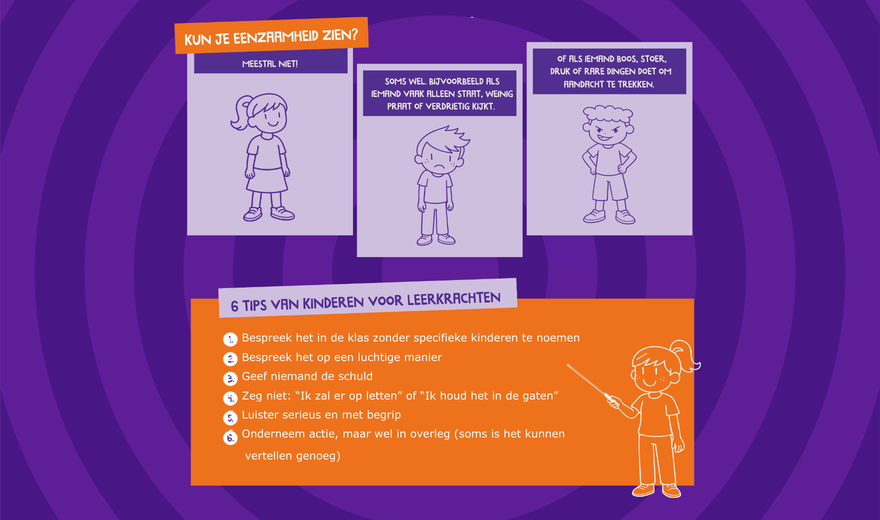
For children in grades 6, 7, and 8, we also developed a child-friendly infographic.
The research was conducted by Utrecht University and is an initiative of Kinderpostzegels, in collaboration with Stichting De Kindertelefoon and Join Us.
On to the next step!
Together with various partners, we are developing materials for both children and teachers in grades 6, 7, and 8. These materials will help them learn more about loneliness, recognize signs earlier, and provide tools to discuss the topic safely and openly.
The materials are being developed in collaboration with the aforementioned organizations, KiVa, Vreedzame School, and Young Academy of Life.
With much gratitude to our sponsors: 'Eén tegen eenzaamheid' (One against loneliness) from the Ministry of Health, Welfare and Sport, SOD & Fie van der Hoop Fonds, and the Noaber Foundation

Research 2024: 'How can we prevent loneliness'
In 2024, Utrecht University and the Verwey-Jonker Institute, commissioned by Kinderpostzegels, conducted research into loneliness among children. We were shocked by the results. In every classroom, two to three children often or always feel lonely. This is true even at primary school.
Download the report 'How can we prevent loneliness'.
This research also utilized representative data from the 'Young after corona' study, conducted by Utrecht University and the Trimbos Institute.
“The fact that so many young children feel lonely is very concerning. Especially since we already know what the long-term consequences can be. Loneliness undermines the strong foundation every child needs, and that can have an impact throughout their entire life.”
- Sofie Vriends, director Kinderpostzegels